Is AI hurting scientific credibility?
What 1,000+ scientists and reviewers say about responsible use in grants and papers.

Professor of Psychology and Psychiatry, University of Pittsburgh

Professor of Medicine, Harvard Medical School

Team Leader, Azienda USL – IRCCS di Reggio Emilia

Professor for the Department of Melanoma Medical Oncology at University of Texas MD Anderson Cancer Center

CEO & Scientific Director of the Ludwig Institute for Cancer Research and Bloomberg Distinguished Professor of Cancer Medicine at Johns Hopkins
In Spring 2026, BioRender surveyed 1,063 active scientists, including 489 peer reviewers and 276 grant reviewers, about how they use AI and how much they trust it. While adoption is high (79% use at least one AI tool), trust is low: 81% of peer and grant reviewers trust AI-generated content less than work produced by humans.
The clearest takeaway from the data is that research is most credible when it doesn't include AI-generated figures. AI is useful for early-stage exploration and brainstorming, but has not yet cleared the bar for finished scientific figures in papers and grants. That said, technology and policies continue to evolve, and BioRender is resurveying regularly to track shifts over time. Researchers can always stay up-to-date by visiting our AI resources page.
For scientists who do use AI, the data shows four key ways to maintain credibility in the eyes of reviewers:
“There is a place for the responsible use of AI in science and scientific communication. But scientists are skeptical by nature. If we lose that fundamental quality in the Age of AI, are we still scientists? Or just unquestioning machine operators? For now, I often have unresolved reservations about authorship, rigor, validity, and originality when I see AI generated content.”

Professor of Psychology, Psychiatry, and Clinical Translational Science, University of Pittsburgh
AI is everywhere, but reviewers don’t trust it
Adoption has grown fast, with 79% of scientists using AI for figures, and more than half using it weekly or monthly. 29% of scientists use AI for data visualizations, and 33% have used AI-assisted figures for peer-reviewed publications, where accuracy is critical.
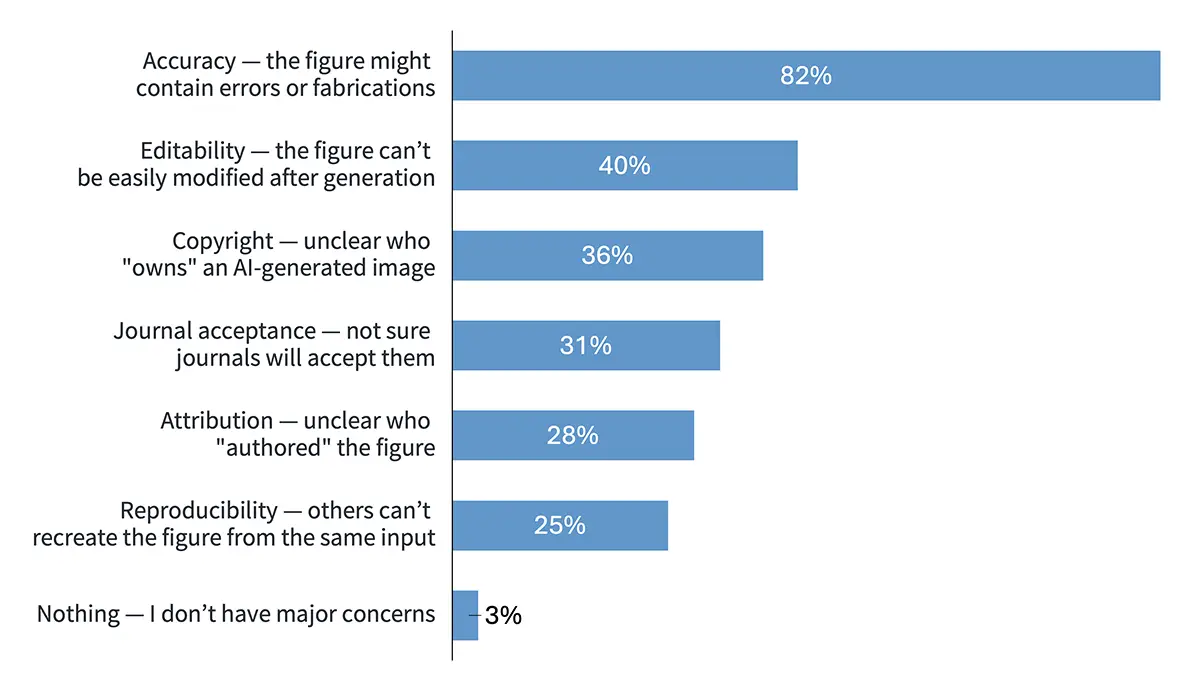
The problem is, grant and peer reviewers don’t trust these figures. When asked to rate trust in scientific figures, only 10% trust fully AI-generated figures, vs 74% trust fully human-created figures. Figures made with AI but edited by humans rated were trusted by 54% of scientists, suggesting researcher contributions improve AI credibility, but not to the level of fully human-made figures.With 82% of reviewers citing accuracy and scientific correctness as their top concern, the message is clear: AI can assist, but human judgment and editing remains essential.
Suppose you came across a figure in a published paper. How much would you trust the figure’s credibility in the three scenarios below, all else equal?

“In science, every figure carries implications and the scientist is expected to own them. With AI-generated content, accountability becomes murky. For this reason, human supervision is needed in every piece of scientific content produced.”
Team Leader, Azienda USL – IRCCS di Reggio Emilia
As an author, what would concern you most about submitting AI-generated figures?
The compliance risks are real
Most major journals prohibit, restrict, or at a minimum require very specific disclosure on AI figure generation, yet 63% of scientists say they either cannot find or have not checked their journal's AI policy. Among those who did look, only 30% found a clear one. This is a significant compliance risk: violating journal or funder policies can damage a researcher's standing and jeopardize future publications, but most people don't know the policies.
“What worries me the most about AI-generated figures in research is that figures are one of the most common places for people to commit plagiarism and AI will only increase this troublesome trend.”
Professor of Medicine, Harvard Medical School
Grant funders are also taking notice. NIH's Notice NOT-OD-25-132, effective September 25, 2025, instructs reviewers to reject grants substantially developed by AI, and NIH has stated it uses AI-detection tools on incoming submissions.
For authors, the stakes for non-compliance are high. A figure submitted to a journal or funder that prohibits AI can put a researcher in poor standing and make future publications or funding harder to secure. A disputed figure also raises broader questions about credibility: did the author verify the work? Can the rest of the paper be trusted? In a field where credibility shapes funding, promotion, and collaboration, a single challenged figure can leave a mark that outlasts the correction.
The regulatory direction is becoming harder to ignore, with AI policies across the U.S. and EU shifting from voluntary guidelines to mandatory requirements.
How to use AI without eroding trust in your research
The reality is that AI is here to stay, but using it responsibly is critical to maintaining trust in research. Only 5% of scientists want to ban AI completely in research. Instead, 77% want mandatory standards and requirements that let them use AI without putting their reputation, grants or papers at risk.
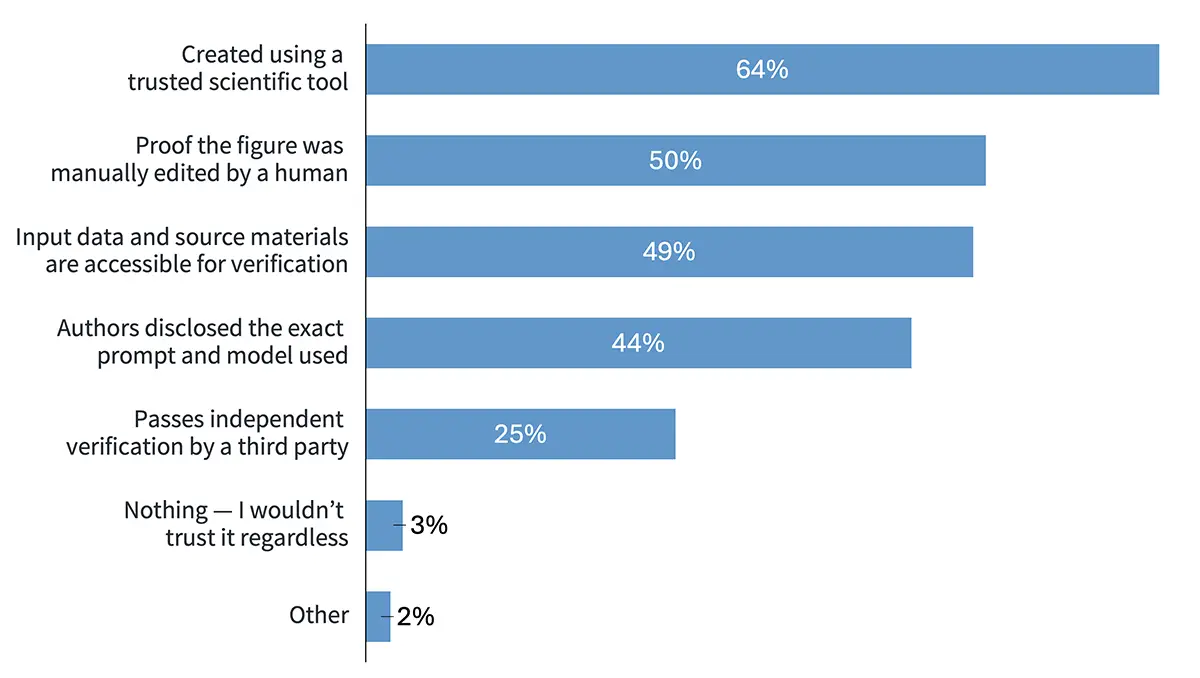
Which of the following would make you most trust an AI-generated figure?
At a time when reviewer attitudes toward AI vary widely and policies are still being worked out, our survey data points to a set of recommendations to follow to maintain scientific credibility.
“What is a threat to scientific integrity is the ability of AI to generate figures from non-existent data. Hence, I believe ’trust’ rests on the integrity of the investigator who generates the figure, whether manually or via AI.”
CEO & Scientific Director of the Ludwig Institute for Cancer Research and Bloomberg Distinguished Professor of Cancer Medicine at Johns Hopkins
Recommendation 1 · Determine if AI is right for the job
The data is clear: AI-generated figures are not yet trusted enough to serve as formal scientific communication. They have a role as a starting point for brainstorming and exploration, but not as a finishing tool for publication-ready work. For researchers who want to protect their credibility and sidestep the complexity of disclosure requirements and evolving journal and funder policies, the simplest path is to avoid AI in scientific figures altogether.
Recommendation 2 · Use AI tools built for science
For researchers who do use AI, tool choice matters. General-purpose AI tools, and the science-focused products built on top of them, draw from indeterminate sources and provide no clear record of what was generated or edited. That audit trail is exactly what peer reviewers and emerging regulations like the EU AI Act require. Purpose-built scientific tools, by contrast, use vetted imagery and maintain that record by design. Scientists already recognize the difference: 74% say they trust purpose-built scientific tools over general-purpose AI, and 64% identify a trusted scientific tool as the single factor most likely to increase their confidence in a figure, by a wide margin.
Recommendation 3 · Ensure adequate human review and editing
AI output should be treated as a first draft, not a finished figure. The best scientific tools are built with this in mind, giving researchers the ability to edit, refine, and apply their own judgment before the work is finalized. The data makes a strong case for this approach: trust scores climb from 2.03 to 3.49 out of 5 once a human has edited an AI-generated figure, closing roughly 70% of the gap with figures created without AI entirely.
Recommendation 4 · Disclose what you used and how
When AI is used, disclosure is non-negotiable. While disclosing AI involvement may invite some skepticism, it is far less damaging than the suspicion that comes from not disclosing at all. Scientific norms are already moving in this direction: 60% of scientists say AI tool usage should be disclosed by default. On August 2, 2026, the EU AI Act will make that expectation a legal requirement. Journals, publishers, and funding institutions are increasingly expecting authors to name the specific model or tool used, describe the extent of their oversight, and provide additional context about how AI contributed to the work.
Recommendation 5 · Comply with your journal's policy
Before submitting, always check the AI policy of your target journal, publisher, or funding institution. If the policy is silent, or your work falls under multiple conflicting policies, default to the stricter standard.
In practice, this is harder than it sounds: 63% of scientists in our survey could not locate their journal's AI policy. When in doubt, err on the side of caution and avoid AI-generated figures in your submission. BioRender tracks the latest in journal and grant agency policies on AI, and provides researchers resources for navigating confidently. Learn more about the latest policies by visiting our AI resources page.
“The presentation of scientific information requires a process of understanding, which no AI model can achieve. Someone who relies exclusively on AI-produced material and has not practiced the process manually is at risk for complacency and inattention to detail, two major contributors to scientific stagnation.”
Professor for the Department of Melanoma Medical Oncology at University of Texas MD Anderson Cancer Center
BioRender is built to help researchers communicate their science with confidence. Whether the goal is journal publication or faster exploration, BioRender gives researchers the flexibility to choose the right approach for every figure. Our library of 50,000+ expert-vetted icons and templates makes it easy to build polished, fully compliant figures in minutes. For researchers who want to use AI, BioRender's tools are purpose-built for science: underlying imagery is vetted by scientific experts, and the workflow is designed to keep researchers in control of the final output. That includes generating fully editable drafts of protocols, timelines, and flowcharts, turning text prompts or sketches into custom figures, creating custom icons, and more.