Tulane’s investment in visual science communication produced measurable results. Researchers who incorporated BioRender visuals into NIH grant submissions during the time Tulane provided the sitewide license secured 3X the funding compared to proposals that did not use BioRender visuals.
These outcomes help demonstrate that clearer science communication is becoming a competitive advantage for researchers at the institutional level. With BioRender, that quality is now accessible to every scientist at Tulane. “Now, anyone can do that level of graphical abstract,” Zwezdaryk noted, “you see it in almost every grant now.”
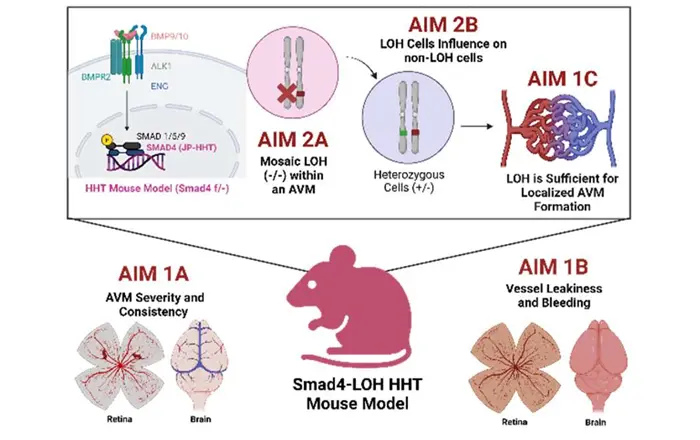
In multiple cases, Tulane researchers also ranked in the top percentage of applicants, reinforcing the role of clear communication in proposal competitiveness. PhD candidate, Adella Bartoletti, who studies rare vascular disease in the Cell and Molecular Biology department, used BioRender visuals in two recently funded grant applications, and the reviewer feedback pointed to a consistent theme.
“The reviewers were consistently saying the procedures make sense, they're well thought out, easy to understand,” Bartoletti noted. “Both applications were funded. For the NIH (NHLBI) grant, I was in the top 14% of applicants, and for the AHA grant, I was in the top 3%.”
Beyond increased funding outcomes, BioRender also notably accelerated the pace of research communication across the university. Research teams are now creating scientific figures up to 6X faster, allowing the researchers to invest that time saved in producing higher quality grants and publications.
Time savings is more than just a matter of convenience for researchers. It accelerates grant cycles, shortens manuscript preparation, and removes friction from collaboration. When a journal requests a last-minute graphical abstract, Bartoletti delivers it before the deadline with no revisions required. When a colleague describes an idea on a whiteboard, Dr. Green can translate it into a polished figure the same day to keep everyone on the same page.
Tulane‘s adoption of BioRender reflects a broader shift in how the university approaches research. By standardizing high-quality visual storytelling across its research community, Tulane transformed scientific communication from a time-consuming formatting task into a strategic advantage.