Comparison of BioRender alternatives for scientific figures
Compare BioRender with the main alternatives, from design tools to AI figure generators.
Feature | BioRender | Design tools (e.g., PowerPoint, Adobe, Canva, Inkscape) | AI Models (e.g., Gemini, ChatGPT, Copilot) | AI Tools (e.g., SciDraw, Illustrae) |
|---|---|---|---|---|
Journal & grant compliant: Accepted by all major journals and grant agencies* |  |  |  | |
Copyright safe: Built with copyright compliance in mind | | | | Unverifiable |
Clear IP: Your figures, your rights | | | Unverifiable | Unverifiable |
Enterprise Secure: SOC2 certified platform | | | | Unverifiable |
Scientifically accurate library: 50,000+ peer-reviewed icons and templates | | | | |
Fast & easy illustration: Create figures in minutes, not hours | | | | |
Publication-quality: Polished, beautiful images without design expertise | | | | |
Editable: Easily customizable, including AI images | | | | |
Consistent: Standardized visual language across teams | | | | |
AI-assistance: AI image generation for fast first drafts | | | | |
Guided figure making: sketch, build, and edit scientific figures with an AI agent | | | | |
Collaborative: Shared templates, team libraries, & real-time collaboration | | | | |
Consolidated: Figures, posters, presentations, and data analysis all in one place | | | | |
Say goodbye to endless prompting
Leo by BioRender helps you plan, sketch, and build better scientific figures in minutes, keeping every element editable.
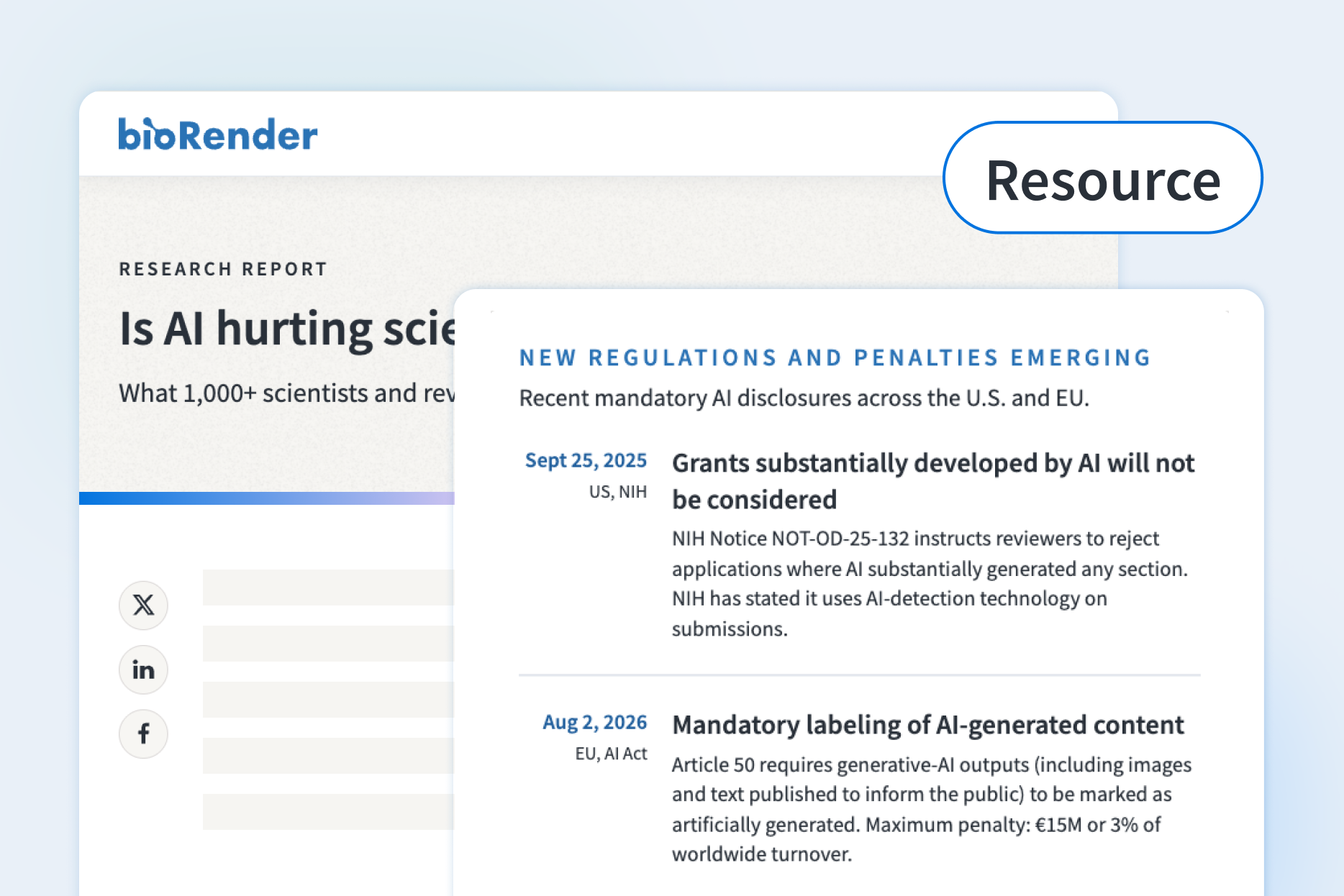
Navigating AI in Scientific Communication
Most major journals and NIH grants restrict or prohibit AI-generated figures. Learn how to use AI responsibly so your research meets the standards of top journals and grant funders.
BioRender's attention to detail, from layout precision to icon accuracy, reflects the same standard of rigor Iapply to my own research. That's why I trust it for scientific communication.

Si-Han Wu
PhD, Professor
Biomedical Engineering at Taipei Medical University




Keep your data secure and controlled
BioRender is SOC 2 Type 2 certified, with encryption in transit and at rest. Your data is private by default, and access controls ensure only authorized teammates can view or edit your work. Learn more in BioRender’s Trust Center.
FAQs
BioRender offers 50,000+ PhD-reviewed icons and an intuitive design canvas where scientists can create figures in minutes, not hours. BioRender helps researchers create beautiful, polished visuals that are consistent across teams. Adobe Illustrator, Canva, and PowerPoint were not built for scientific communication. Creating a complex biological diagram in Adobe Illustrator typically takes 10–20 hours and requires significant design skill. Canva and PowerPoint are faster than Adobe Illustrator, but have no scientifically reviewed icon libraries and no standardized visual language across teams.
General-purpose AI tools lack the context to get the science right every time. They also visualize science inconsistently and produce flat files you can’t edit. BioRender provides you with actual figure-making expertise and the chance to edit every element. With Leo by BioRender, the first AI agent for scientific figures, you can plan, sketch, build, and edit figures in minutes. You can also provide BioRender AI with a prompt to generate fully editable figures in seconds.
BioRender combines AI-assisted figure creation with 50,000+ PhD-reviewed icons, built-in collaboration, and a compliant design system, giving research teams one platform for both exploration and publication. General-purpose AI tools like ChatGPT, Gemini, and Copilot are not built for science: there is no scientifically reviewed icon library, no cross-team collaboration, no easy editing capability, no consistency across figures, and no connection to data analysis, graphing, posters, or presentations. If scientific journals allow AI-generated images, they may require use of a dedicated scientific illustration tool like BioRender.
AI scientific figure tools like SciDraw and Illustrae require text or reference images – there's no ideation or early sketching. They also generate icons that aren’t scientifically vetted and have no published security certifications. BioRender provides you with end-to-end AI figure-making expertise, a library of scientifically vetted icons, and security and privacy settings that keep your data secure and controlled. With Leo by BioRender, the first AI agent for scientific figures, you can plan, sketch, build, and edit figures in minutes. You can also provide BioRender AI with a prompt to generate fully editable figures in seconds. BioRender combines AI-assisted figure creation with 50,000+ PhD-reviewed icons, built-in collaboration, and a compliant design system, giving research teams one platform for both exploration and publication. BioRender is also SOC 2 Type 2 certified, with encryption in transit and at rest.
BioRender combines a library of 50,000+ PhD reviewed icons with an intuitive design canvas to create figures in minutes, all within one platform. Tools like Bioicons are asset repositories, not figure creation tools. Researchers still need a separate design application to build the actual figure, which adds steps and raises the question of whether that secondary tool meets journal and grant standards.
BioRender's free plan lets researchers create up to 3 figures per month. Paid plans start at $35/month with unlimited figure creation, plus AI figure credits from $5/month.
AI-only tools like FigureLabs start at $9/month, but the figures they produce are not accepted by most major journals or NIH grant applications. Adobe Illustrator starts at $22/month but requires significant design skill; building a single biological diagram typically takes 10 to 20 hours. Icon libraries like SciDraw and Bioicons are free but require a separate design tool, adding cost and workflow complexity.
Yes, Leo by BioRender is the first and only AI agent built for scientific figures. Unlike generic AI image tools that give you a prompt box and one flat picture, Leo starts by asking focused questions about your key message, audience, and components to plan your figure with you. It then provides a sketch that you can mark up by crossing out components or drawing missing steps that Leo builds into your polished figure. Leo leaves every component editable so you can update each label, arrow, and icon by hand, or by chatting more with Leo.
Researchers can also generate figures in seconds with BioRender AI by providing a full prompt. BioRender's native AI features include custom icon creation, fully editable flowcharts, protocols, and diagrams from text prompts, and complete figures generated from a sketch, reference image, or text prompt.
BioRender's AI operates within a SOC 2 certified, IP-clear platform with easy tools for cross-team collaboration, helping teams create a standardized language for visual communication.
BioRender's core illustration tools provide access to 50,000+ icons reviewed for biological and anatomical accuracy by PhD scientists. Figures built from this library are fully editable, publication-ready, and compliant with NIH grant requirements and top journal policies including Elsevier, Springer Nature, and Science. BioRender's AI tools are built within that same compliant platform, letting researchers generate and explore figures from text prompts, sketches, or reference images without leaving the trusted environment.
Policies around the use of AI-generated figures vary widely in the life sciences. Always check your journal or funder's policy before submitting.
- Journals often restrict or prohibit scientific figures that are fully AI-generated. If journals allow AI-generated images, they may require use of a dedicated scientific illustration tool like BioRender.
- Grant funders like the NIH explicitly prohibit applications that are “substantially developed” by AI. But most don’t have a policy specific to AI-generated figures.
- Both publishers and funders regularly require that the use of generative AI be disclosed.
You can always use BioRender's AI tools for early-stage planning and visualization. Minimal AI editing features, such as background removal or text edits on existing icons, are also generally compatible with journal and grant requirements. If you’re creating figures for a journal or grant funder that restricts or prohibits AI-generated figures, you can use BioRender AI for early-stage planning, then build the final figure using BioRender's core illustration tools. Learn more in our AI resource hub.
Yes, but free options come with tradeoffs. BioRender’s own free plan lets you create up to 3 figures. Free tools like Bioicons (an icon library), Inkscape, and draw.io cost nothing, but they weren’t built for scientific figures. You have to find or draw your own icons, and you don’t get a PhD-reviewed library, team collaboration, or consistent styling across figures. If journals allow AI-generated images, they may require use of a dedicated scientific illustration tool like BioRender.
It depends on what your journal or funder requires. For publishing, check three things: Is the figure editable? Do you clearly own it or have a license for it? Does it meet the journal’s policy on AI-generated content?
- Design tools like Illustrator and PowerPoint are accepted, but they take more time and have no scientific icon library.
- General AI tools like ChatGPT, Gemini, and Copilot make figures that most major journals and the National Institutes of Health (NIH) restrict or prohibit. Ownership of the figure is also unclear.
- BioRender figures built from its reviewed icon library are editable and consistent with the policies of Elsevier, Springer Nature, Science, and more. If journals allow AI-generated images, they may require use of a dedicated scientific illustration tool like BioRender. Visit our AI resource hub for more information.