


Navigating AI in Scientific Research

Resources, policies, and perspectives to help scientists use AI with confidence

How and when to use AI in your research

idea icon

Idea generation & exploration

AI is helpful in early-stage exploration: creating scientific figures for brainstorming, rough visualization, and internal presentations.
Explore BioRender AI tools
submit icon

Submitting to a journal

Most major journals restrict or prohibit fully AI-generated scientific figures. Always check your journal's policy on AI usage before submitting for publication.
grant icon

Applying for a grant

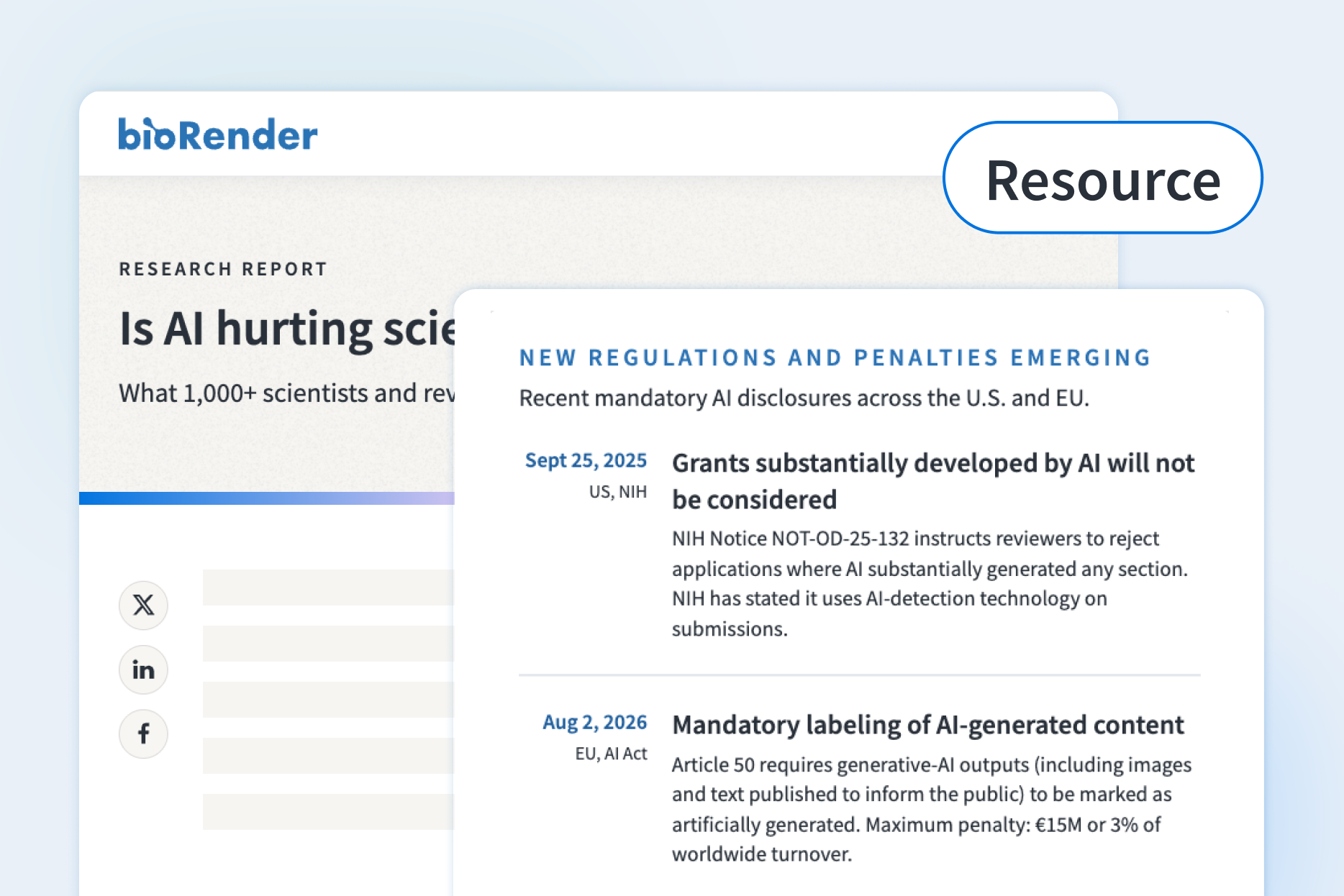
The NIH explicitly prohibits grant applications developed by AI, including AI-generated figures. Check your funder's AI policies before submitting.
JOURNAL POLICIES

Journal and grant funder policies

Publisher / Funder
AI figures policy
Disclose & verify

Key requirement(s): AI may be used for simple explanatory schematic images and data-faithful visualizations. Modification of primary research images is forbidden. Graphical abstracts require the use of a dedicated scientific illustration tool. All AI use must be documented in a dedicated AI disclosure statement.

Key requirement(s): AI-generated or enhanced scientific images are not permitted. Exceptions for images directly referenced in articles about AI, reviewed case by case.

Restricted

Key requirement(s): AI-generated or altered illustrative figures are not permitted; exceptions require discussion with the editor.

Cell Press (incl. Cell, Molecular Cell)
Disclose & verify

Key requirement(s): Cell Press journals follow Elsevier's figure policy. AI may be used for simple explanatory schematic images and data-faithful visualizations. Modification of primary research images is forbidden. Graphical abstracts require the use of a dedicated scientific illustration tool. All AI use must be documented in a dedicated AI disclosure statement.

Wiley
Disclose & verify

Key requirement(s): AI permitted for data visualizations and research illustrations (diagrams, flowcharts) with disclosure. AI-edited photographs and AI-generated factual or evidential images are not permitted. Disclose tool, version, and role in the figure caption.

PLOS ONE
Disclose & verify

Key requirement(s): AI contributions must be disclosed in the methods or acknowledgments section, including tool name, how it was used, and which parts of the study were affected.

NIH (Grant Applications)
Prohibited

Key requirement(s): Applications or sections substantially developed by AI will not be considered original ideas of the applicant.

BMJ
Prohibited

Key requirement(s): AI-generated figures, illustrations, and visualizations are not permitted. AI tool use must be disclosed in the Methods section and cover letter.

JAMA Network (incl. JAMA, JAMA Oncology, 11 other titles)
Prohibited

Key requirement(s): AI-generated figures, illustrations, and visualizations are not permitted across all JAMA Network journals.

IEEE
Disclose & verify

Key requirement(s): AI-generated content must be disclosed in the acknowledgments section with the AI system identified and specific sections noted.

Policies as published by each major publisher. Individual journals within a publisher family may be stricter — always verify with your specific journal before submitting. Last updated: June 2026.
security icon

Secure with BioRender

BioRender’s AI tools are compliant with all major journals and grant funders. We stamp BioRender-created data in a verifiable way, so figures are directly traceable to a certified source — keeping your research private and protected.

Additional reading for researchers

Is AI eroding trust in scientific research?

In Spring 2026, BioRender surveyed over 1,000 scientists and reviewers on how they use and trust AI in scientific publications. The results show a growing gap between AI adoption and trust. The report breaks down what's driving this shift and what researchers can do to publish with confidence.

June 16, 2026  ·  10 min read

Meet the Medical Illustrators Who Hand-Build BioRender's 50,000+ Icons

Every BioRender icon and template is hand-built by trained medical illustrators and science designers with deep scientific expertise. Here's a behind-the-scenes look at the research and peer review process that goes into getting the science right.

FAQs

Does using an AI tool expose your unpublished research?

Some AI platforms use submitted inputs such as prompts, reference images, and uploaded data to improve their models. For researchers working with unpublished findings or clinical data, this is a real concern. BioRender is SOC 2 certified, so your unpublished research stays private.

Who owns the copyright on an AI-generated figure?

Copyright ownership of AI-generated content is unsettled and subject to active litigation. BioRender's AI generates figures from BioRender-owned icons and assets, so the license transfers directly to researchers, removing copyright ambiguity.

What happens if a journal finds AI-manipulated imagery in your published work?

Journals are actively reviewing published work for AI-generated imagery. Figures built in BioRender are accepted by top journals including Elsevier, Springer, Nature, and Science, giving researchers a clear, compliant path.

Can I use AI-generated content in top scientific journal submissions?

AI-generated content, including figures and images, is restricted or prohibited by most major scientific journals. Always check your journal's editorial policies before submitting.

Can I use AI generated figures in an NIH grant application?

As of NIH's July 2025 Notice, NIH will not consider applications that are either substantially developed by AI, or contain sections substantially developed by AI, to be original ideas of applicants.